Chiswick Auctions’ Silver & Objects of Vertu department continues to grow in both breadth and international reach. From European and Colonial American pieces to rare silver from Iraq, Persia, Burma, China and India, our auctions regularly showcase high-quality silversmithing from across the globe.
Born in Gujarat before 1850, Oomersi Mawji rose from humble beginnings to become the court silversmith to the Maharaos of Cutch and the Maharajas of Baroda. By the late 1860s, his intricate silverwork had garnered the attention of Indian nobility, and he went on to exhibit at the 1878 Exposition Universelle in Paris, launching his reputation internationally.
His work was later retailed in London by Liberty & Co. and Proctor & Co., before the workshop finally closed around 1930. Mawji’s sons continued the family tradition, maintaining a remarkably high standard of craftsmanship.
Mawji's work is celebrated for its labour-intensive chased decoration, not to be confused with repoussé. This involved applying molten resin and wax (kil) to support the silver as it was repeatedly worked to create extraordinary surface detail.
Wynyard Wilkinson, in his seminal book Indian Silver 1858–1947, praised Mawji’s mastery:
“Working the silver with ingenious skill and patience, Oomersi Mawji and his sons raised the quality of decoration on Cutch silver to an art form.”
Today, his works are housed in major museum collections including the Victoria & Albert Museum, and his reputation stands equal to the finest silversmiths in Europe.
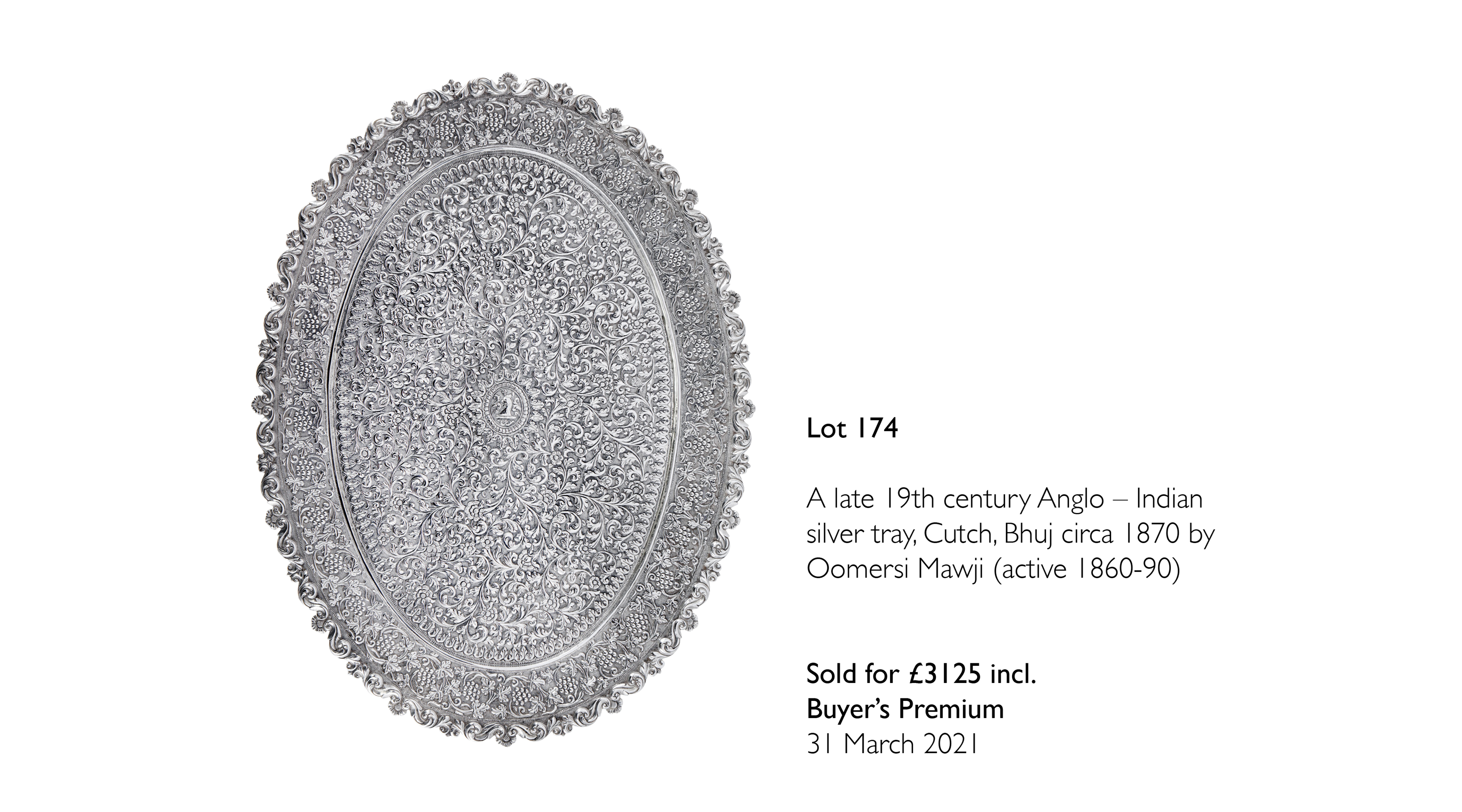
Head of the Silver & Objects of Vertu, John Rogers, commented: “The five lots we are offering in our forthcoming sale show the intricacy and imagination that Oomersi Mawji and his workshop employed in the creation of superb silverware. It is a joy to be able to bring more of these beautiful works before the public so that established collectors as well as new eyes may witness the joy that is Indian silversmithing.”
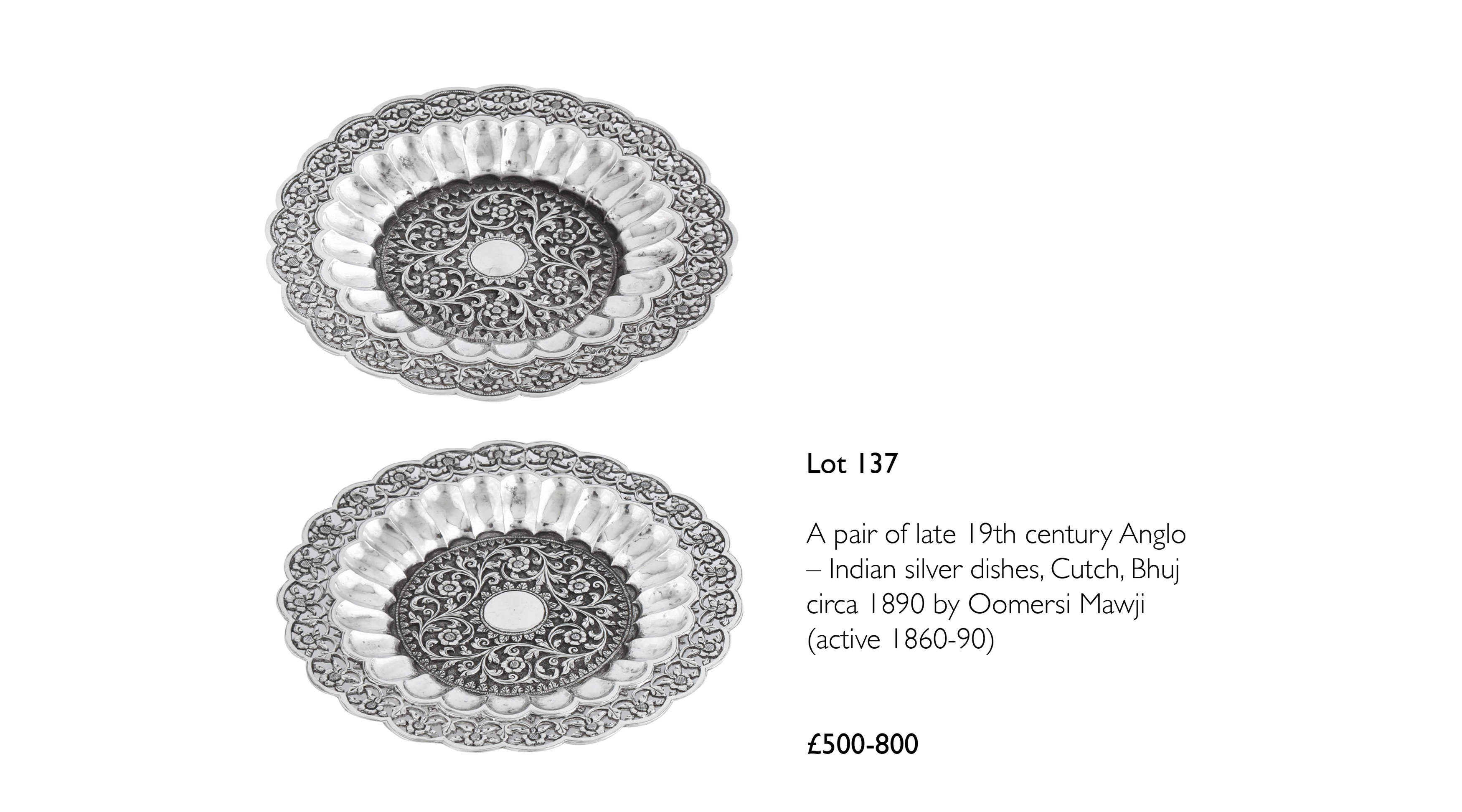
With scalloped edges and pierced rims, these dishes are adorned with delicate foliate scrolls and rosettes framed with acanthus leaves.
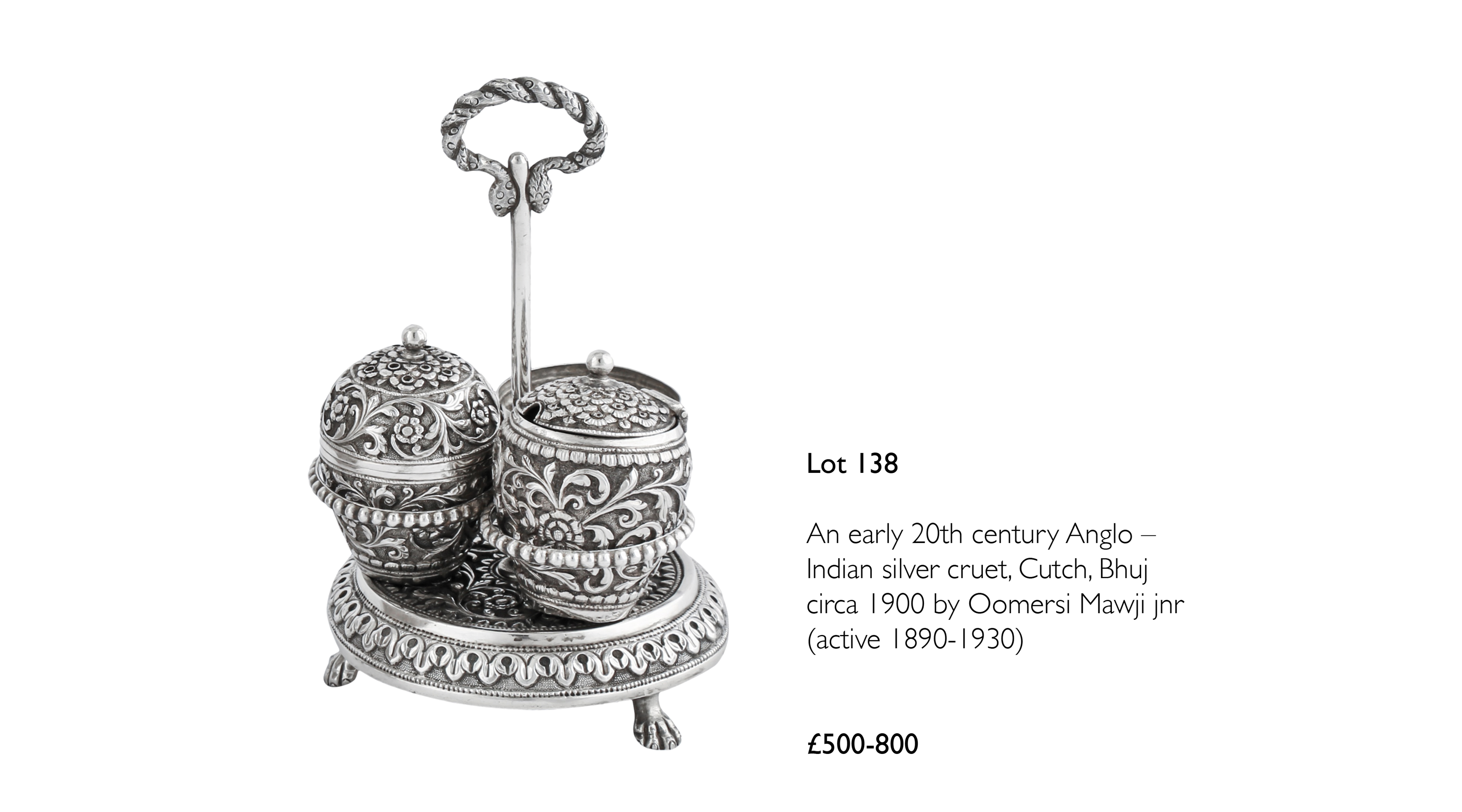
Featuring entwined serpent handles and intricate chased detailing across pots and base, this Victorian-era cruet exemplifies the blend of artistry and utility.
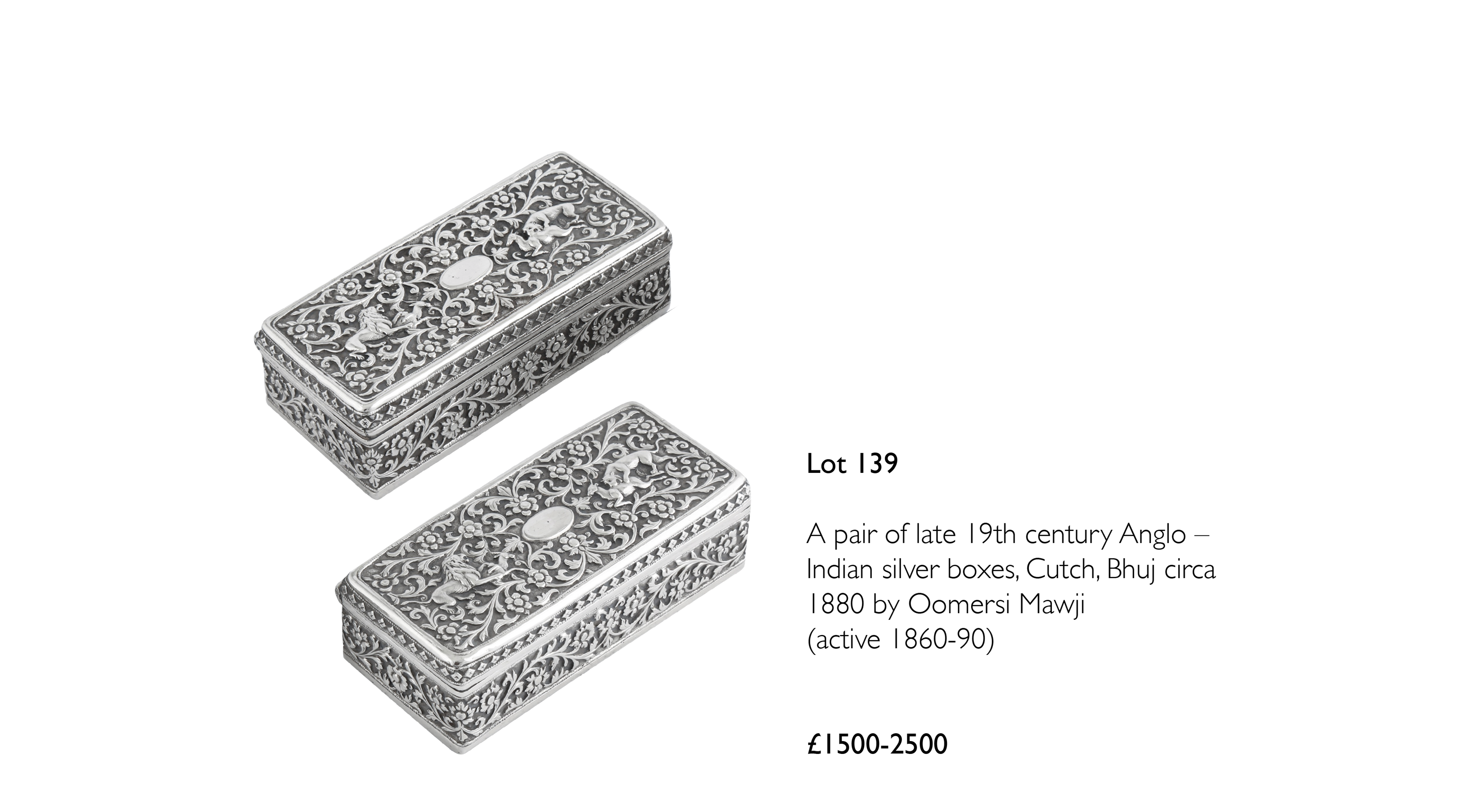
With deep chased scrollwork, these small-scale boxes display remarkable attention to detail. Each lid features a lion or tiger attacking a gazelle, framed within a border of lozenges.
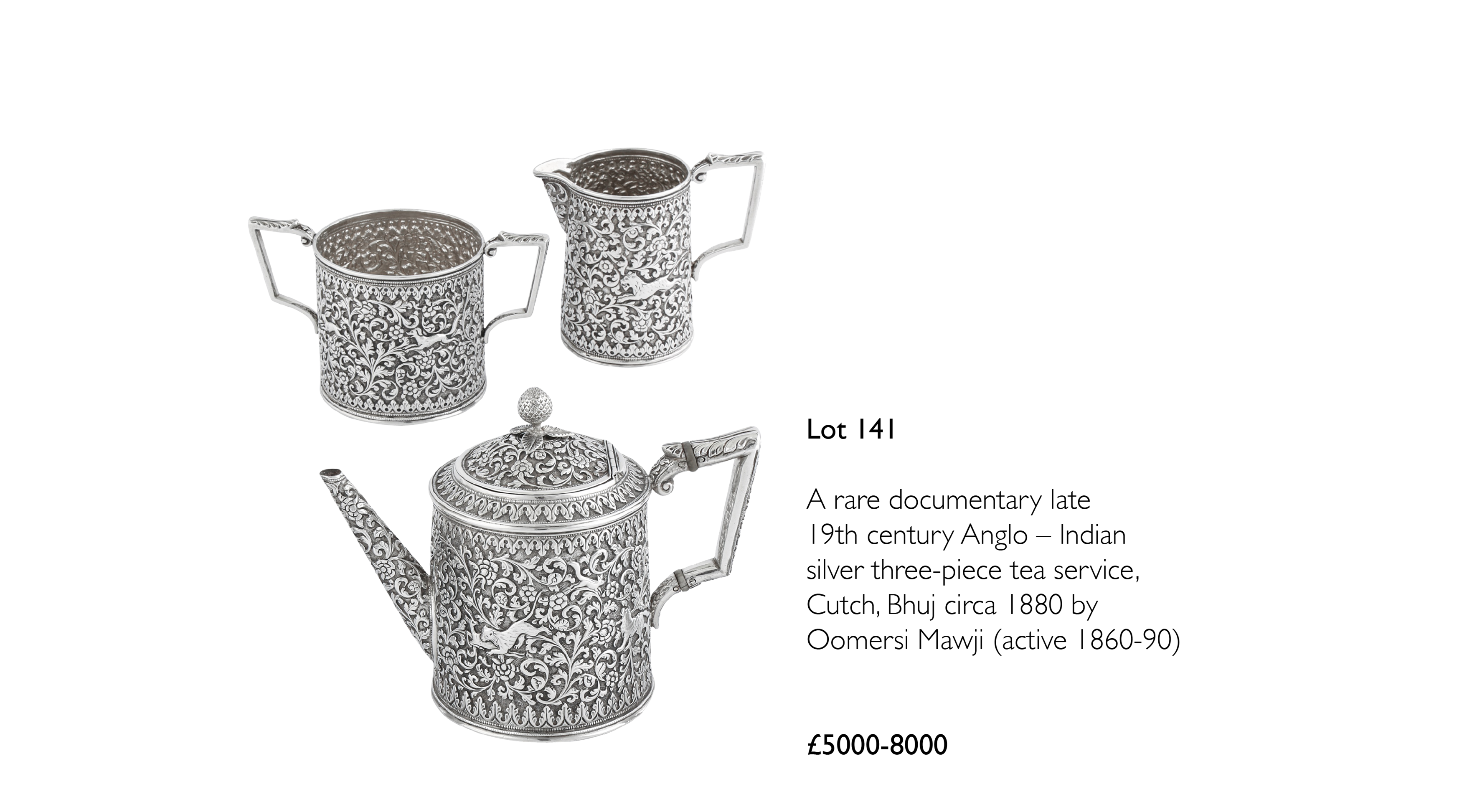
This standout lot includes a teapot, milk jug and sugar bowl, all heavily decorated with floral scrolls, animals and elegant borders. Notably, the teapot lid features a lychee finial. This exact set is referenced in Wilkinson’s Indian Silver 1858–1947.
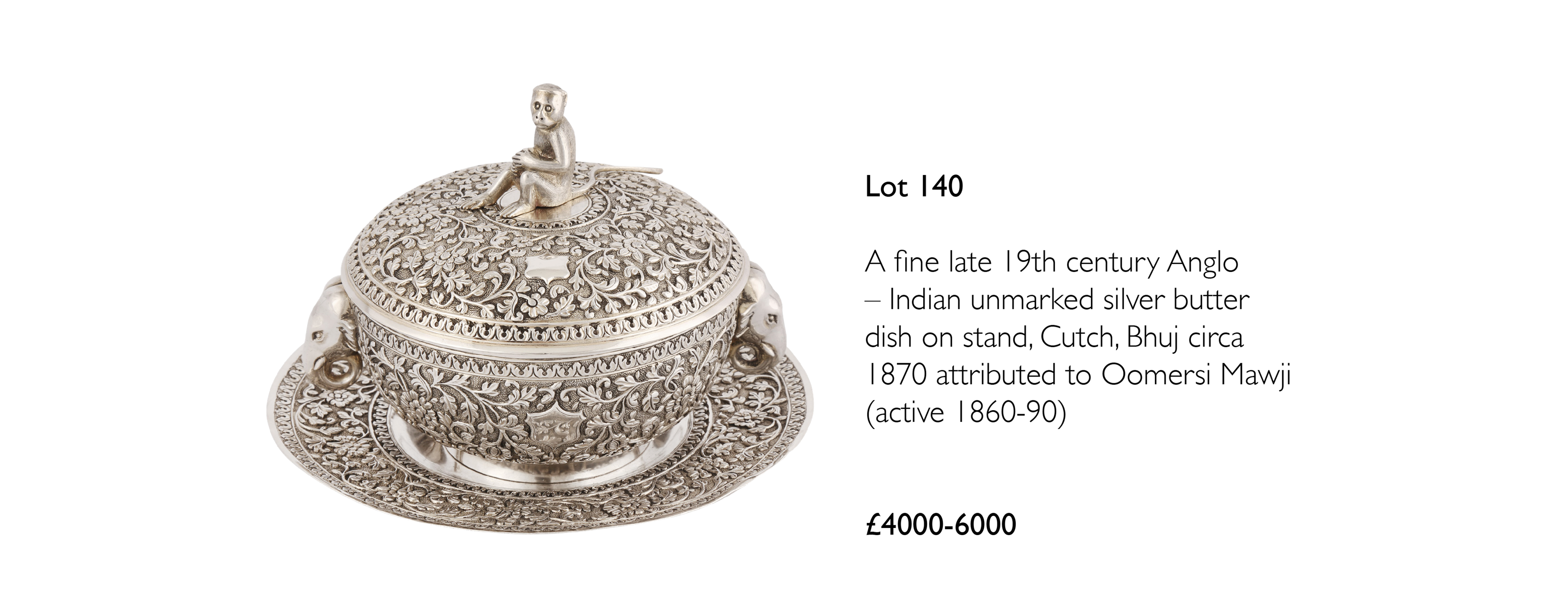
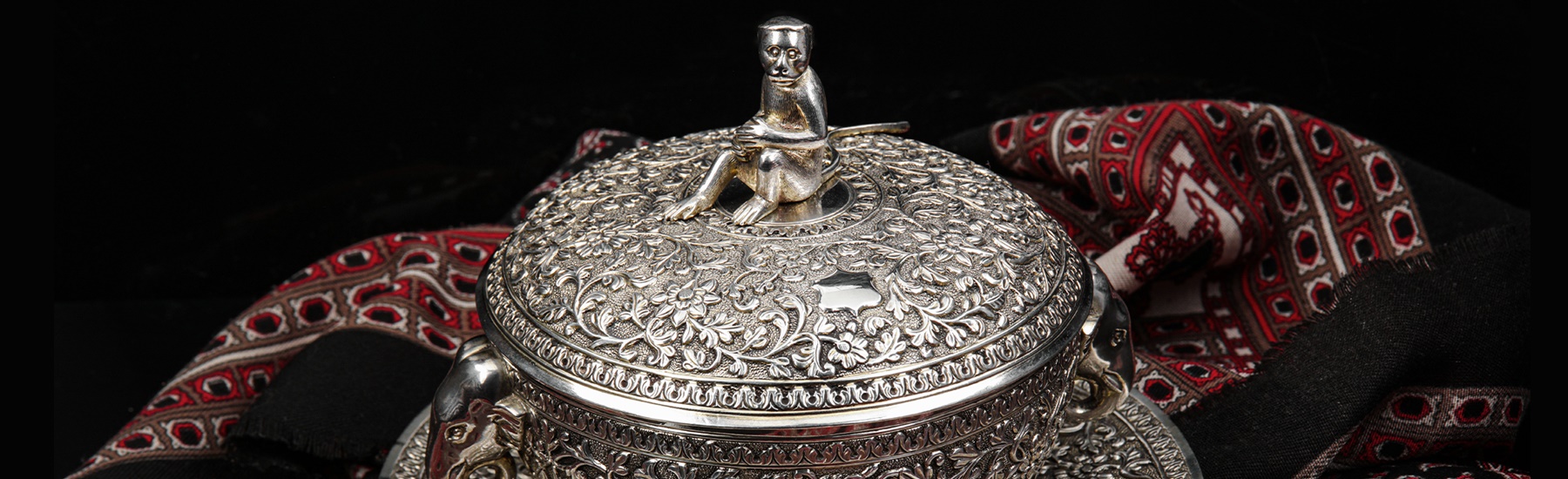
Although unmarked, this rare Raj period piece is stylistically attributed to the Mawji workshop. The handles are cast as elephant heads, and the lid is topped with a humour-filled finial of a bonnet macaque holding a mango.
For lot 140 we have commissioned Wynyard Wilkinson to produce a short text putting this piece in context within the oeuvre of Mawji:

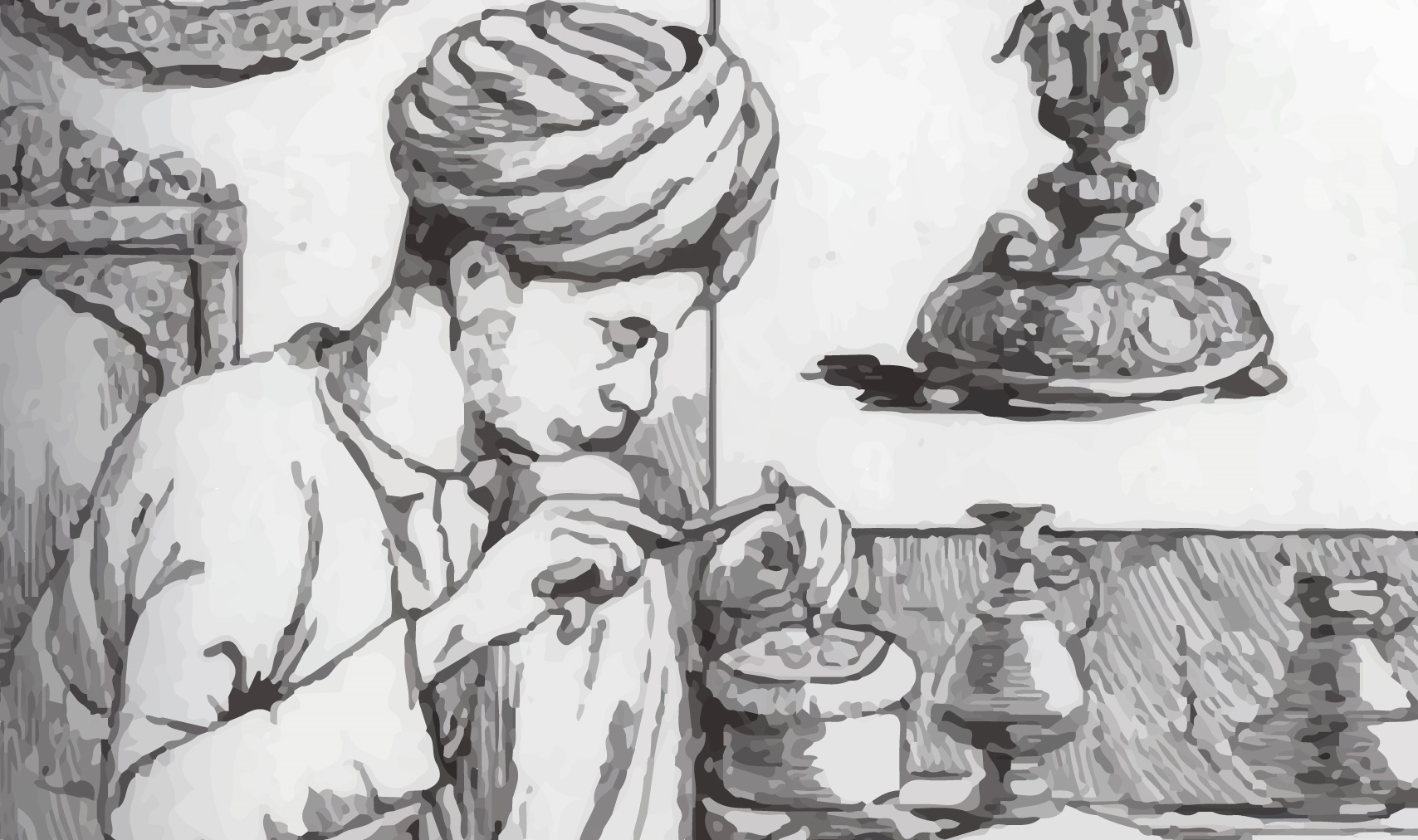
Of all the Indian silver producing artisans in India, one name stands out as associated with pieces of the very finest quality: Oomersi Mawji. Pieces by this accomplished master began to appear circa 1860 and they continued to be produced by his sons and grandsons well into the twentieth century.
There is no doubt that Oomersi Mawji was one of the most gifted silversmiths working anywhere in the world during his lifetime. His understanding of form, proportion and decoration, his willingness to devote extra labour to a piece to truly perfect it to world-class standards, and his use of an extremely high grade of silver (often 98 per cent pure) combine to lend even the most mundane objects an aura of grandeur, placing this artist in the ranks of the finest craftsmen. The standard of quality, workmanship, and design, often enhanced with a little humour (the monkey finial in this instance) were passed to the artist’s progeny and characterise their work as well.
With its sensuous forms and intricate ornament, the work of Oomersi Mawji has enormous appeal. Every painstaking detail covering almost the whole surface of each object is an element drawn from nature. Sinuous plants coil and wind in infinite undulating, swirling patterns through which emerge stylised poppies, which curl and twist to reveal every stage of flowering.
The dish and stand showcased here serves to illustrate many of the characteristics of the best Cutch workmanship. Here, the fine casting of the elephant head handles, whose incorporation into the design emphasises the three-dimensional aspect of the decoration of this piece. The rather bored looking monkey finial only adds to its visual appeal.
- Wynyard Wilkinson
9 June 2022
If you own silver items and would like a free, no-obligation valuation, contact John Rogers, Head of Silver & Objects of Vertu:
john.rogers@chiswickauctions.co.uk
Or simply submit an Online Valuation today.