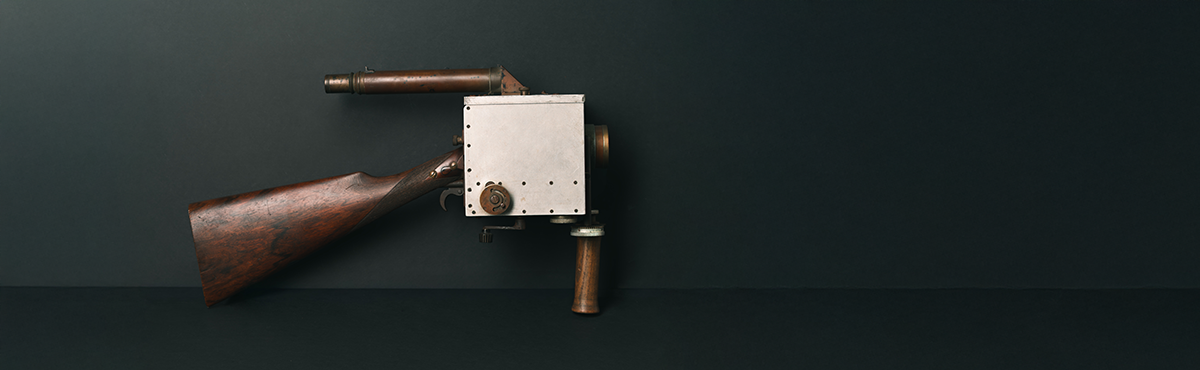
Chiswick is thrilled to be offering an estate collection from one of the pioneers of wildlife photography at the turn of the 20th century, Cherry Kearton.
Picking out some of his favourite lots from the sale is Hector Skevington-Postles, an Emmy-winning Director of Photography with a background in Zoology. Having spent the past two decades capturing the natural world across all seven continents and over 78 countries, we couldn't think of anyone better to invite to look over the collection with Austin Farahar our Photography specialist and Associate Director.
Brothers Cherry and Richard Kearton were not only photographers, but inventors, explorers, and early conservationists, driven by the radical idea that animals should be studied and recorded alive, in their natural habitats. At a time when nature was still largely documented through illustration or indeed hunting trophies, the Keartons transformed how the natural world was observed, recorded, and understood. Their books, including With Nature and a Camera and Wild Nature’s Ways helped shape early attitudes towards wildlife conservation in Britain and beyond.
Cherry Kearton’s pioneering work in wildlife photography gave him a rare and practical understanding of the technical challenges involved when photographing subjects in an unpredictable environment. Cameras of the period were heavy, slow, and fragile, unsuited to the task at hand for the Keartons, forcing innovation.
During the First World War, Kearton applied his technical knowledge to military use. Registering a number of patents relating to camera design. These developments were adopted for aerial reconnaissance and used by the British Admiralty.
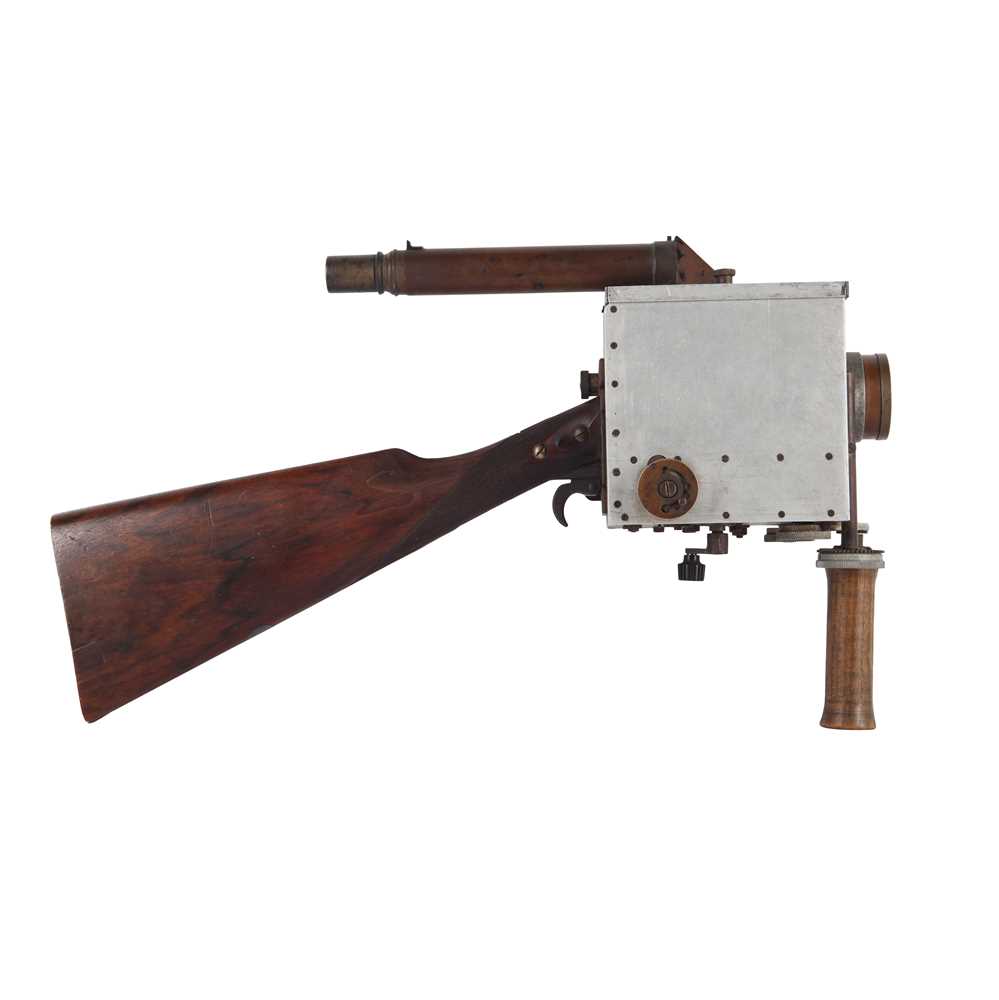
Cherry Kearton's Prototype Rifle Camera c.1919, Estimate £2,000 - £3,000
After the War, Kearton returned to nature photography and revisited his early mahogany and brass half-plate rifle camera, first illustrated in Wild Nature’s Ways (1903). He refined the design further into a far more robust design, incorporating self-advancing functionality on medium format roll film. This predated the popular German self winding camera, the ‘Robot 35’, and perhaps the most famous of all Leica accessories, the Leitz New York Camera Rifle from the mid 1930s.
"Seeing and even having the rare chance to hold this remarkable object, it felt surprisingly more aligned with modern photographic equipment than I thought possible. A century ago, this was the cutting edge and, in many ways, the beginning of everything that followed for my industry. Despite its outward strangeness compared to modern DSLRs or film cameras, it carries the essence of everything we still use today. Conceptually, it is remarkably close to how wildlife photographers continue to think: constantly needing precision at distance, this incredible invention achieved stability, reach, and for the day… speed. The incredible innovation of the spring-loaded film advance; after exposure, the camera advanced automatically, no manual winding between shots. Getting one step ahead of the natural world, once again, the modern-day equivalent, our motor drives, high speed shutters and burst shooting. The hardware evolved. The intent did not.
I love the idea that he has taken an object specifically designed to take life and instead created something to capture it. If more people of his time did the same, then so much of our beautiful wildlife may still be here today. With inventions like this he started the ball rolling on a whole industry that has led and shaped people’s perceptions of the natural world over the past 100 years, it’s hard to know what the impacts of his work really has been." - Hector Skevington-Postles
Kearton presumably used his rifle camera on his photographic safari in East Africa, where he famously met Theodore Roosevelt a couple of months after his presidential term ended, a figure widely associated with early conservation in the United States. A photograph and correspondence between the two during this trip are offered in the next lot. Unlike Roosevelt. Kearton was determined to “shoot with the camera, not the gun,” his rifle camera embodies that philosophy. It is an object of ingenuity and functional design, and its importance within the history of camera development and early conservationist practice cannot be overstated.
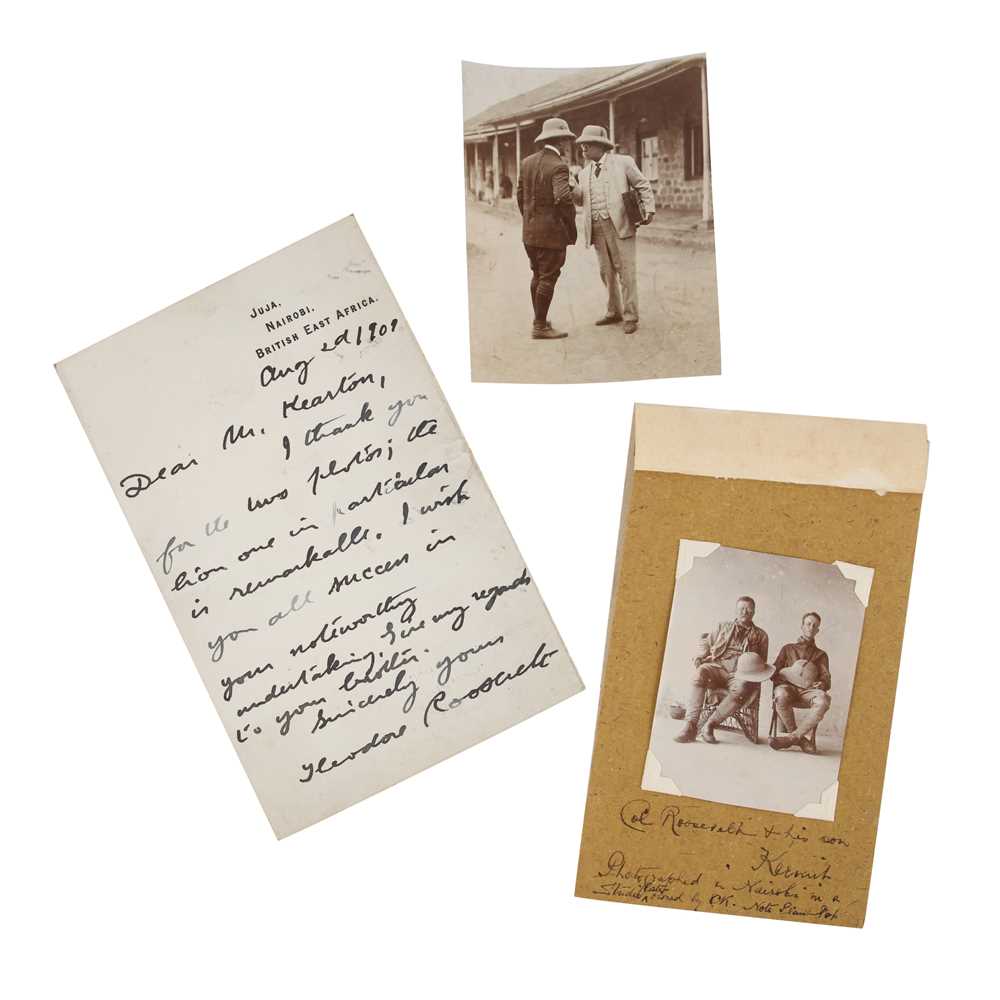
Cherry Kearton F.R.P.S & Theodore Roosevelt, 1909, Estimate £800 - £1,200
The accounts of Kearton’s flight aboard the Spencer Airship No.II over London in May 1908, later recalled in his book Adventures of Animals and Men (1935), are both thrilling and terrifying in equal measure. While other reports of the flight differ slightly from Kearton’s own, it is important to note that he was never one to shy away from a good story!
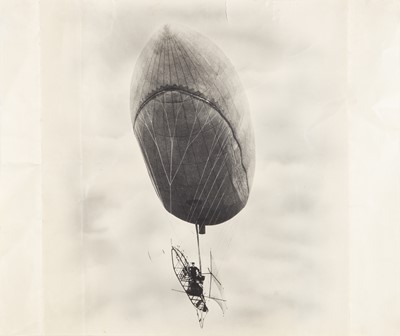
During the flight, the airship encountered some serious difficulties and began to descend in an uncontrolled way. The situation became increasingly dangerous and Spencer reportedly gestured for Kearton to throw the heavy camera ballast overboard, it was lashed to a gondola basket so instead, as documented by Kearton, “since I am an incurable optimist, I thought that perhaps I shouldn’t be killed after all and in that event I had now an absolutely unique opportunity of securing pictures”.
"Two huge pillars of wildlife photography that allow us to keep pushing things on are advances in technology and the cold hard determination of the photographer. This couldn't be summed up better than in this lot and the story behind it. It showcases perfectly the mindset of anyone truly hell-bent on getting the shot. It would be amazing to think what Cherry Kearton would make of today’s drones and what we can do with them, his intent on the aerial perspective was spot on, and one we still doggedly chase today, just with a little less risk." - Hector Skevington-Postles
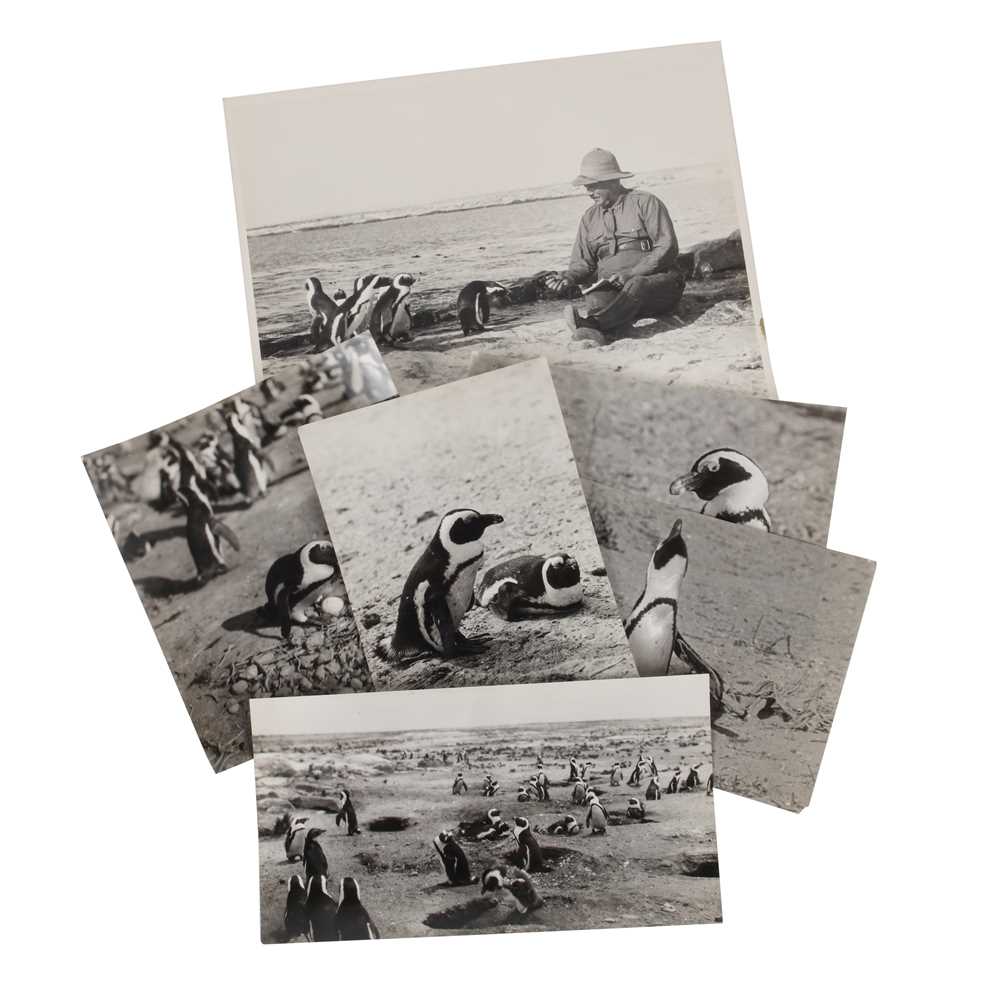
Writing in his account of Cherry Kearton’s career, author John Bevis describes one of the photographer's most punishing field experiences on Dassen Island, just off the coast of South Africa.
Kearton first attempted to visit the island in 1921, the weather conditions were so extreme that his vessel remained at sea, battling the elements while repeatedly attempting to make landfall. When he finally succeeded, the visit was brief, with only a cursory inspection of the island before returning to the boat, recording his relief “... and so I got away from Penguin Island, which I shall never see again. Nothing would induce me to revisit the place, especially in stormy weather”.
Despite this declaration, he was soon drawn back. Kearton and his wife returned and became the only human inhabitants on the island, staying in a warden's shack and with what he estimated as “five million” black footed penguins.
"These images speak to the same feeling, unchanged from his time to ours. The tough, rugged conditions in which we need to work and the single-minded determination to capture what we came for. I have almost identical shots in similar colonies and stories of living for almost two months in a shack crammed amongst a colony of 106,000 walrus (Image below, included in the collection from that trip). Tough times always but the rewards were worth the pain, something Cherry Kearton I’m sure would agree with." - Hector Skevington-Postles
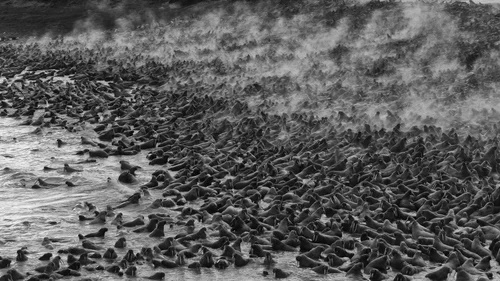
In the high Russian arctic, seventy percent of the world’s population of Pacific Walrus haul-out onto one beach
With special thanks to Hector Skevington-Postles Emmy Award-Winning Director of Photography | Natural History & Documentary Specialist
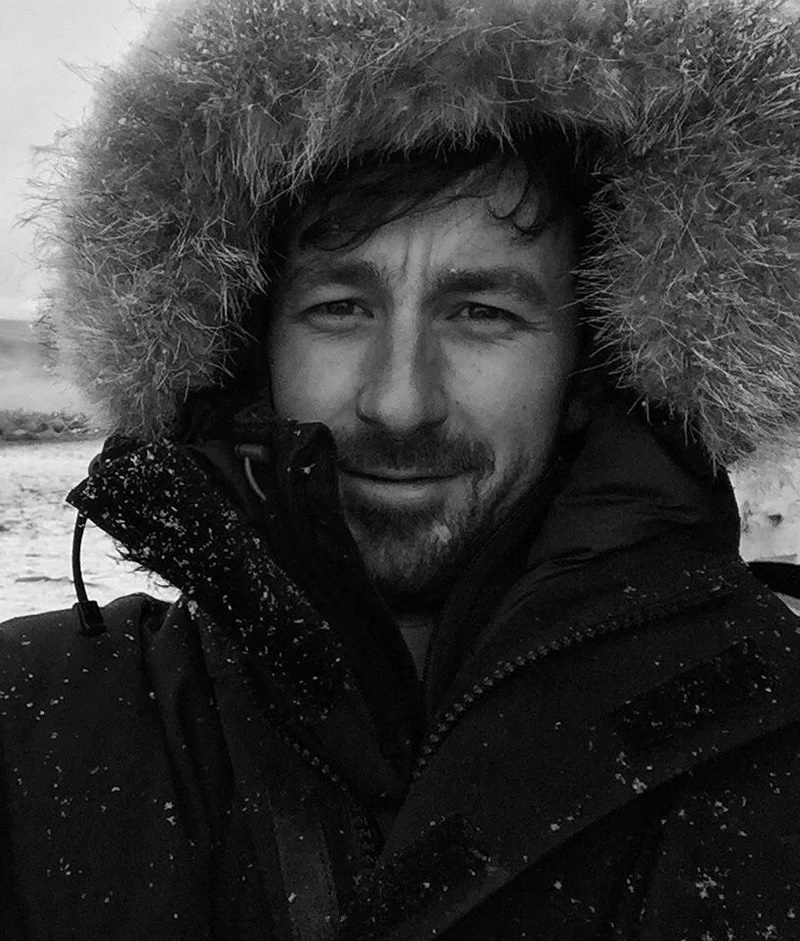
An Emmy-winning Director of Photography with a background in Zoology, I’ve spent the past two decades capturing the natural world across all seven continents and over 78 countries. My work spans blue-chip, observational documentary, IMAX, and cinematic releases for BBC, Netflix, AppleTV, Disney+, and National Geographic.
His storytelling is deeply grounded in observational techniques, both in wildlife and human-centered narratives. Having filmed presenter-led shows such as Tribes with Gordon Buchanan, Planet Earth Live, and Springwatch, as well as intimate human stories in remote regions, from yak herders in Earth’s Natural Wonders II to Buddhist monks in BBC Mountains.