
Many years ago, before I discovered the wonder of podcasts and the ability to insulate yourself within an even tighter echo chamber of audio-broadcast values, I was a big fan of audiobooks. I was one of the few people who successfully burnt through their Audible credits each month, rather than letting them quietly accumulate at the bottom of the direct debits page on my banking app.
I remember joyfully listening my way through the economic findings and vinous descriptors of Mike Veseth. I thoroughly enjoyed the schadenfreude of The Billionaire’s Vinegar. Then one day, as my old Ford Mondeo growled its way through the Cotswolds, I began listening to Shadows in the Vineyard. It is a very well-written account of the blackmail attempt against Domaine de la Romanée-Conti, involving the random poisoning of its vines. The whole affair unfolded and collapsed in a relatively short space of time, but Maximillian Potter tells the story with enough drama and flair that it has stayed with me ever since. So when a bottle comes up, as they invariably do, I am reminded of the sad tale of the man who tried to blackmail the world’s most expensive vineyard.
This is one of those many sources of knowledge that I have accrued without really noticing it. It is why I can spot a capsule that is the wrong colour on a fraudulent bottle, or why I can bore anyone at a barbecue to tears about terroir and grape varieties when they foolishly say something as inflammatory as, “all Malbec tastes the same”. There is a threshold of infamy within the wine and spirits world where I have simply learned the stories over time, and they sit somewhere in the back of my head. Meanwhile, the face of someone I worked with for the best part of a decade slips from my mind like spilt Perrier-Jouët being wicked off the dinner table by an off-brand kitchen cloth.
So when an item presents itself for valuation and elicits a genuine “huh?” from me, I get quite excited. At that stage, the value or condition hardly matters. My mind just spins its gears, finds nothing to bite onto, and so my mouth can only produce that one useful syllable: “huh?”
One such item came up recently. It was innocuous and not particularly valuable, but it sat entirely outside the limits of my accumulated knowledge. It was a can of beer.
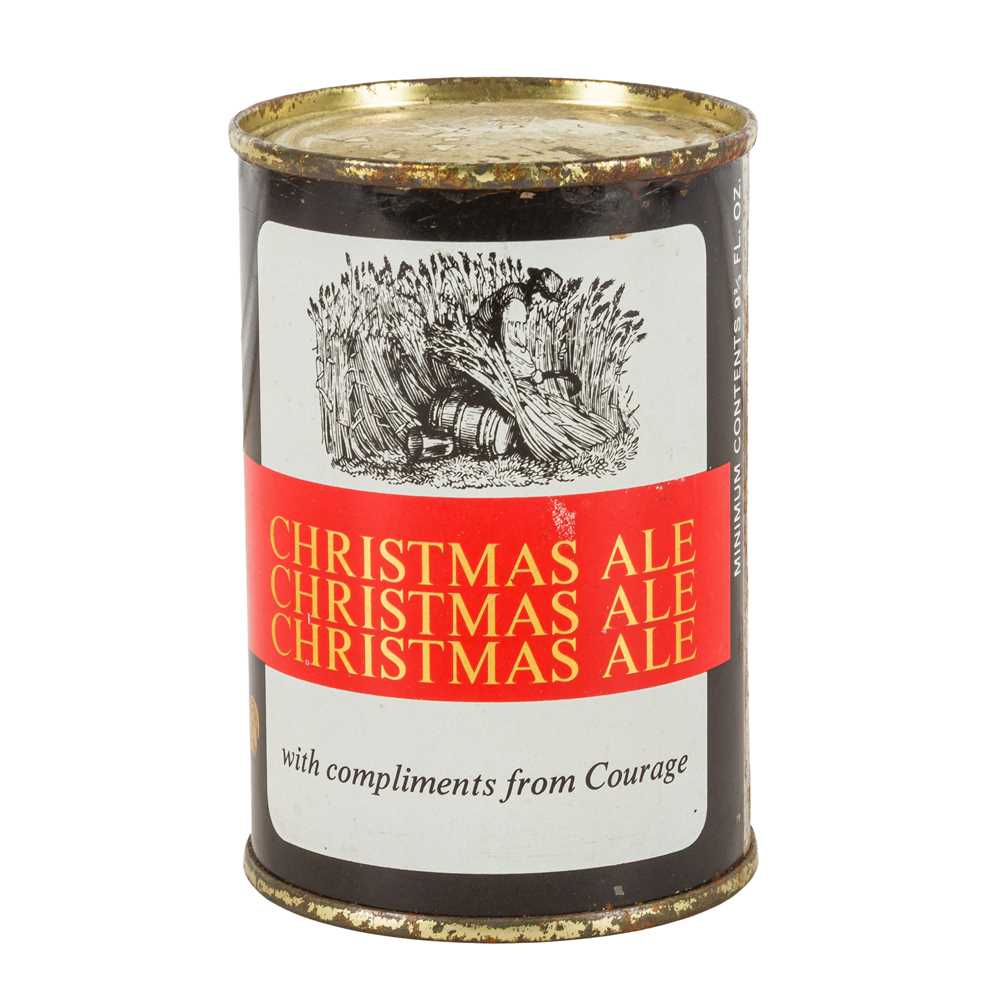 Courage Chirstmas Ale (Circa 1965-68) Estimate £80-£140
I frequently have people bring me old beer, and most of it falls well below any threshold of sensible return for the client. This one, though, was different. To start with, it was in a tin, really. Not a can as such. There was no ring pull, no crown cap atop some oddly trumpet-like protrusion. It was a completely sealed tin. Show me an old whisky and I will look at the closure straight away. Spring cap, cork and wax, screw top: all of these things give me a rough guide to age. But beer in what looked essentially like a tin of condensed milk? That stumped me.
So I took to my keyboard and began looking for people who knew more than me, which, as it turns out, is almost everyone in the world. Then I refined the search to people who knew more about old beer cans than I do, and the list shrank considerably. Thankfully, there was a short list of collectors, and only one who seemed to have been quoted in the media. Better still, he was kind enough to respond to my out-of-the-blue email. Better still again, he had access to various online forums where he could put my images and questions to a wider hive mind of collectors, who helped narrow down increasingly nuanced details.
For instance, we found an upper limit to the tin’s age: 1968, the year ring pulls began to appear on beer cans. One of my favourite shortcuts when dating spirits is knowing that 1973 was the point at which alcohol moved from proof to ABV, and volume shifted from fluid ounces to centilitres, millilitres or litres. This mystery tin had a volume marking on the side, but I already knew it predated the move to centilitres, so what use could that be?
Well, it turns out that until 1965, there was no requirement to state a minimum volume on beer containers. A pint bottle could be half full and that was simply that. No volume statement required, and no guaranteed relationship between the size of the container and the amount of liquid inside. That meant the tin had to date from the relatively small window between 1965 and 1968. Which, believe it or not, also helped us identify where it had been brewed, based on the timeline of where the brewery moved, expanded, and closed sites over its long history.
This helped a lot. It meant we could start looking for when the Christmas Ale was sold.
Except it was never sold.
At this point, I had a date, I had a location, and I had a tin with a name on it. But Courage had never sold a Christmas Ale in the 1960s. So perhaps I really had stumbled upon a limited-edition tin of condensed milk after all.
Once again, the forums of beer collectors came to the rescue with a theory that, in retrospect, made perfect sense. This was not a commercial product at all. It had almost certainly been made as a Christmas gift for brewery workers. It was not uncommon for brewers to make limited-run beers only for employees and their families, and the fact that this one plainly described itself as a Christmas Ale fitted the theory rather neatly.
And there we had it. After many emails back and forth, quick checks of legislation on beer volumes in the archives, and a working knowledge of when and where the brewery operated, we had our answer.
It was enormously enjoyable to put the old detective skills to the test. Too frequently, things come to me that I have already read about, watched videos about, seen in other auction catalogues, or absorbed through repetition, and they bear no real surprises. But occasionally something appears that gives you a good excuse to flex your neurological muscles and practise all the little skills you have learned, just to stop them going rusty.
The Domaine de la Romanée-Conti is far more valuable, and I could tell you a story about that with no effort at all, as most wine people could. But I thought it was worth sharing the tale of an unknown beer tin that strayed onto my desk instead. It is a story you are unlikely to hear elsewhere.
To view current and upcoming lots, click here
If you are considering selling bottles or a collection, our specialists also offer confidential, no-obligation wine valuations and would be pleased to advise.
sam.hellyer@chiswickauctions.co.uk
Submit an Online Valuation