Monica Poole (1921–2003) was a British printmaker whose exquisitely detailed wood engravings have earned her a place among the most accomplished wood-engravers of the post-war period. Born in Kent, Poole endured a challenging childhood: she contracted polio at six months old, leading to significant mobility issues for several years. She lost her elder sister at a young age, and her mother also faced a long battle with tuberculosis. This led the family to spend two years in Switzerland, where Poole first encountered the dramatic mountainous landscapes that would later resonate in her work. These early challenges fostered a naturally introspective temperament, and drafting became a means of observing and engaging with the world around her.
Poole began formal artistic training at the Thanet School of Art, Margate, in 1938. There she was introduced to printmaking, particularly wood engraving, by artist and teacher Geoffrey Wales, himself a student of notable British printmakers Eric Ravilious, Edward Bawden and John Nash. Wales’s facility with texture and fine detail made a lasting impression on Poole.
As with many of her generation, Poole’s developing practice was interrupted by the Second World War, during which she worked for five years in an aircraft factory. In 1945 she resumed her studies, enrolling at the Central School of Art and Crafts in London. Here, under the guidance of celebrated wood engraver John Farleigh, she refined the technical precision and expressive detail that would come to define her practice.
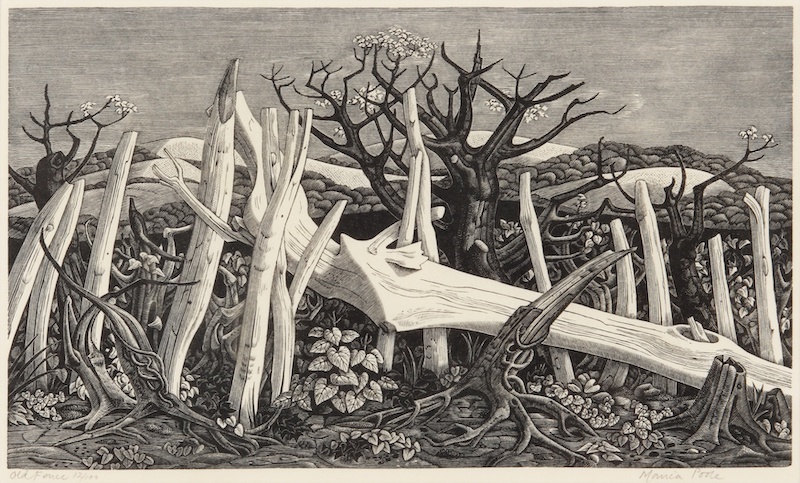
Poole’s work is known for its intricate depictions of organic structures: roots, bones, twisted trees and abstracted natural forms. Often dark, surreal and uncanny, her engravings align with the sensibilities of the post-war British art scene. They also resonate with the unsettling natural imagery found in the work of Graham Sutherland and John Piper. Influenced by the British landscape, Poole favoured complex macro studies of flora and fauna or densely constructed landscapes.
Although her style was initially in step with contemporary neo-romanticism, the movement’s brief lifespan and the declining popularity of wood engraving meant that by the 1950s interest in her work had sharply waned. Even acquiring suitable materials became difficult, as only one firm continued to produce the specialised hardwood blocks required by wood engravers.
Poole married in 1952, and the following decades were marked by both personal and professional challenges. She taught at Tonbridge Adult Education Centre while struggling to find a consistent collector base for her meticulous, traditional prints, works that stood apart from the ascendant movements of Pop Art and Abstract Expressionism.
As frequently occurs in art history, critical taste eventually shifted. By the 1970s, shortly after her husband’s death, Poole’s work began to be re-evaluated, her mastery of technique and distinctive visual language newly appreciated. Between 1977 and 1993 she produced thirty-six engravings, exhibiting with the Royal Society of Painter-Etchers and Engravers and with Duncan Campbell. She became a member of the Royal Society of Painter-Etchers and Engravers in 1967, and a member of the Society of Wood Engravers and the Art Workers’ Guild.
Institutional recognition followed, including a retrospective at the Ashmolean Museum in 1993. Her work is now held in major collections, including the Victoria and Albert Museum and the British Museum. She died in 2003 at the age of 82, having quietly witnessed the renewed appreciation of her life’s work.
Today, Monica Poole is regarded as one of the most distinctive British wood engravers of the twentieth century. Her prints, whilst holding steadfast to the earlier tradition of the medium, embody the highest standards of craftsmanship and elevate the discipline of wood engraving.
In recent years her market has strengthened significantly, as collectors become aware of this diligent artist with outstanding technical precision. Works once valued at a few hundred pounds now routinely achieve several thousand. Her combination of technical brilliance, rarity and distinct aesthetic continues to attract collectors seeking exceptional examples of British printmaking.
If you are new to collecting prints, you may also find our guide How Much Is My Print Worth? helpful for understanding the broader print market and key valuation factors.
Chiswick Auctions would be delighted to assist you with selling works by Monica Poole. Whether you are parting with a single piece or an entire collection, our specialists can guide you through every step of the consignment process.
Poole has a loyal and growing collector base, and our Prints & Multiples department regularly achieves strong results for her work.
For a complimentary valuation, contact prints@chiswickauctions.co.uk or submit your item via our Online Valuation Form.