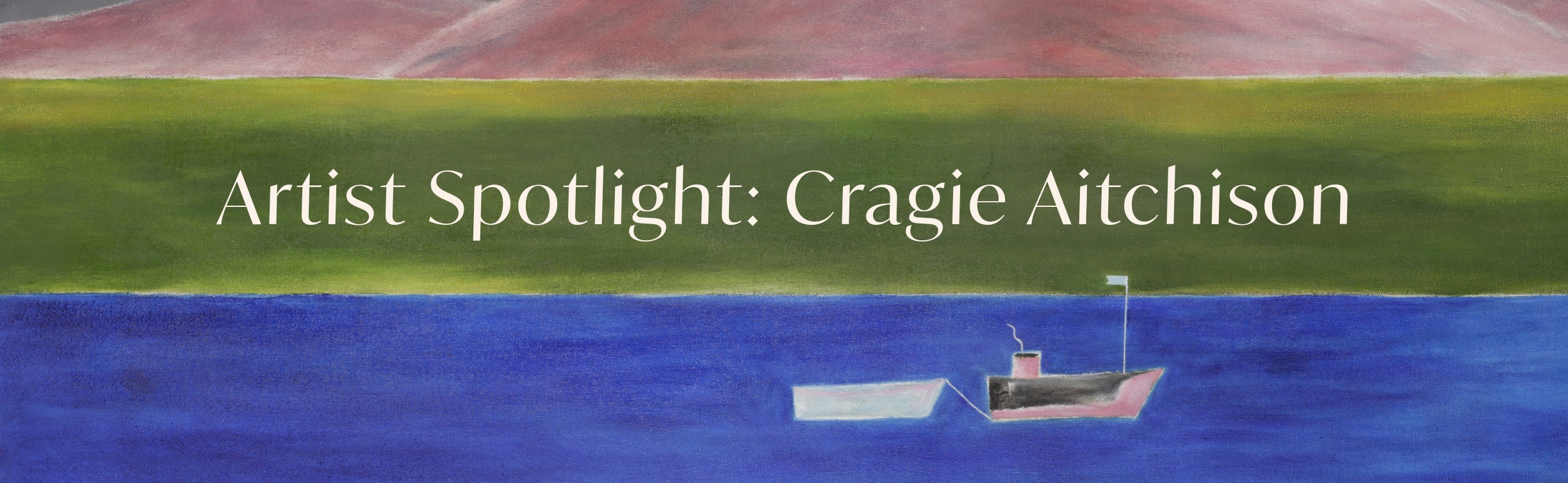
John Ronald Craigie Aitchison was born in 1926 in Edinburgh. Aitchison studied law at the University of Edinburgh before, around 1950, switching to painting and enrolling at the Slade School of Fine Art in London. In 1955, he received a scholarship that enabled him to study in Italy. It was there that Aitchison encountered many of the motifs and painterly traditions that would go on to define his artistic career.
Although inspired by his time in Italy, Aitchison never forgot his native Scotland. The Isle of Arran, in particular, inspired some of his best and most accomplished landscape paintings and remained one of the most significant places in his life and art.
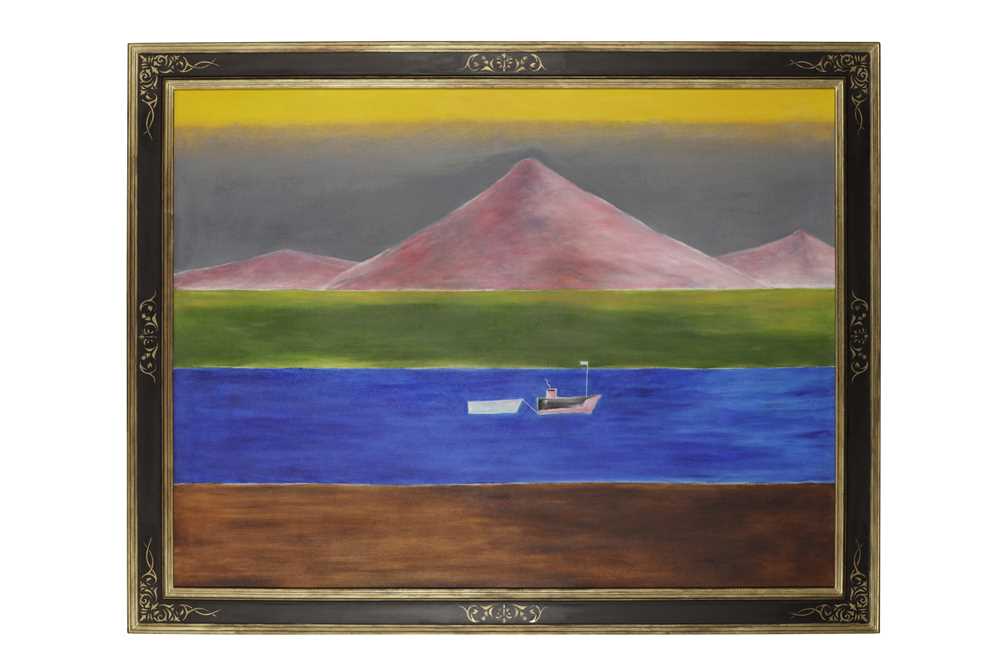
Isle of Arran, Sold for £26,250 Includes Buyer's Premium
Located off the west coast of Scotland in the Firth of Clyde, the Isle of Arran has long captured the imagination of artists and writers alike, with its sense of atmosphere, history and mythology. Aitchison had spent much of his childhood there, and many of his earlier works were painted from photographs taken during these visits. He returned later, after his extensive travels in Italy, and in 1970 scattered his mother’s ashes there alongside his father’s. The island clearly had a profound and lasting effect on the artist. Its distinctive, pyramid-like peak became a recurring motif in his work, and similar forms would later find their way into his crucifixion paintings and other compositions.
The Crucifixion was likewise a recurring theme in Aitchison’s art. When he first saw Christ of Saint John of the Cross by Salvador Dalí, he began a lifelong fascination with the subject. He encountered the painting in 1951, after it was acquired by the Kelvingrove Art Gallery and Museum in Glasgow. Dalí’s vivid and modern interpretation of the Crucifixion would have a profound impact on Aitchison’s own work, and the subject became one with which he is closely associated.

Crucifixion, Sold for £42,500 Includes Buyer's Premium
After a group show at Gimpel Fils in 1954, Aitchison travelled extensively throughout Italy, where his fascination with quattrocento and trecento painting had a profound effect on his style and artistic output.
“I think the story of the Crucifixion is one of the most exciting in the Bible.” – Craigie Aitchison
When he returned, he had his first solo exhibition at Beaux Arts in 1959, one of three, and continued to develop his pre-Renaissance influenced, inimitable naïveté. Aitchison became deeply interested in the interaction between light and dark, and in the spaces between forms. His crucifixion paintings often explore the distances between subjects, using large expanses of intense, flat colour divided into linear segments that heighten the emotional effect of the scene.
While the Isle of Arran and the Crucifixion recur in different colours, forms and scales throughout his work, these were not his only subjects. Aitchison also loved animals and had a particular fondness for Bedlington Terriers, which appear in many of his paintings in a naïve rather than strictly naturalistic style. When his beloved Bedlington Terriers died, he made paintings to commemorate them. He bought his first Bedlington, Wayney, in 1971 and continued to keep the breed throughout his life. Craigie Aitchison’s connection to the Bedlington Terrier was not professional but deeply personal and artistic, which is why the two are so often associated.
Aitchison is not only known for his choice of subject matter, but also for a highly distinctive visual language. He often used strong contrasting block colours and broad areas of flat paint. Despite these large expanses of colour and space, his compositions remain carefully balanced and emotionally resonant.
In many of his portraits, colour is as important as the sitter. His works depart from hyper-realistic representation and instead prioritise lyricism, atmosphere and visual clarity. This is equally true of his still lifes and portraits.
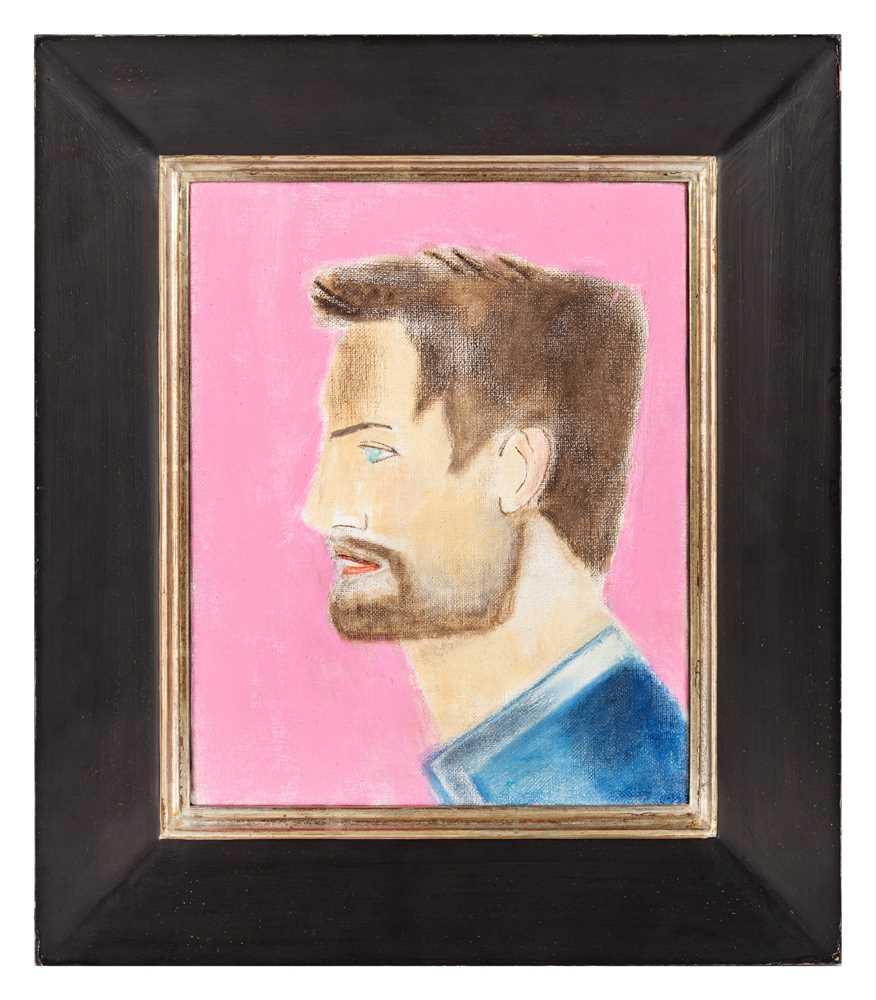
Portrait of Francis Fry, Montecastelli
Estimate: £8,000– £12,000
Sale: 31 March 2026 | 14:00
Aitchison’s admiration for Renaissance art is evident throughout his work, both in subject matter and in style. The Crucifixion, most notably, is a dominant and recurring motif in his art, just as it was in much early Renaissance painting. For Aitchison, Christ is often shown as small, isolated and vulnerable, reimagined within a sparse field of bright and unexpected colour.
His approach to portraiture also reflects both continuity and departure from earlier painterly traditions. This grounding was clearly established in his foundational training at the Slade, as he once remarked to the art historian Andrew Lambirth:
“I couldn’t paint portraits now unless I’d been to the Slade. Every time I start a portrait wherever I am I think I am in that room at the Slade.”
Aitchison’s connection to artistic tradition can be seen not only in his subjects but also in the structure and composure of his paintings. Portrait of Francis Fry, Montecastelli (2002), for example, is composed in a way that recalls Renaissance portraiture. Inspired by artists such as Piero della Francesca, the sitter is placed against a vivid pink ground, with a composition that remains rooted in the conventions of portraiture while unmistakably belonging to Aitchison’s own highly personal style.
His work was shaped by tradition, but never constrained by it. His paintings are deeply personal, peaceful and still, childlike yet emotionally charged, without ever feeling crowded or overworked.
Chiswick Auctions would be delighted to assist with the sale of works by Craigie Aitchison. For a complimentary valuation, please contact modernbritishart@chiswickauctions.co.uk or submit your work via our Online Valuation Form.