31st Oct, 2023 11:00
Islamic Art - Property of a European Collector Part VI

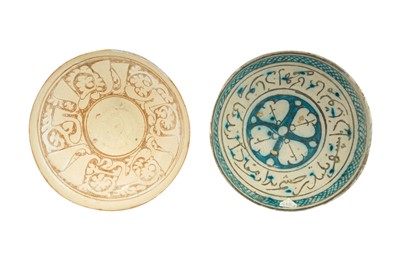


TWO MEDIEVAL IRANIAN POTTERY BOWLS
Possibly Amol, Northern Iran, and Kashan or modern-day Azerbaijan, 11th - 12th century
TWO MEDIEVAL IRANIAN POTTERY BOWLS
Possibly Amol, Northern Iran, and Kashan or modern-day Azerbaijan, 11th - 12th century
Comprising an incised pottery bowl, of typical conical shape, rising to a short and straight rim, the earthenware body covered with a white slip under a transparent glaze, the interior featuring a wide incised decorative band on the cavetto with pseudo-Kufic calligraphy and scrolling vegetal sprays set against a darker, red-coloured background with scribbled infill, the exterior plain, 19.8cm diam. and 7.5cm high; and a black and turquoise-painted pottery bowl, of similar shape, the interior decorated with a central stylised rosette medallion, a free-flowing naskh calligraphic band on the cavetto, and a cross-hatched fretwork band below the rim, the exterior with a radial design of black vertical lines, 19.5cm diam. and 9.2cm high.
Despite their success in the art market of the first half of the 20th century, Medieval Iranian incised wares remain a largely understudied and misunderstood group of wares. They are probably one of the most distinctive groups of ceramics produced in the 11th and 12th centuries; nevertheless, their precise categorisation has not been formalised yet. Pope and Watson tend to divide this production into three sub-groups: Garrus, Amol, and Aghkand, corresponding to the claims of their original find-spots. The most substantial group was excavated at Takht-e Soleyman (West Azerbaijan), but recent archaeological surveys have demonstrated a widespread presence of these incised wares in various other centres in Azerbaijan, as well as in Northern Iran. For further information, please see O. Watson, Ceramics from Islamic Lands, 2004, pp. 253 - 254, and O. Watson, Ceramics of Iran, 2020, p. 147.
A very similar example to our incised bowl can be seen in the Al-Sabah Collection at the Kuwait National Museum, published in O. Watson, 2004, cat. Ia.1, p. 254. Both bowls share the presence of incised decoration against a white slip under a transparent glaze and the characteristic darker tone of the background, in-filled with scribbles. An analogous artistic solution for the background has been adopted by Persian potters on a different bowl in the same collection (cat. Id.1, p. 266), attributed to the "Amol ware" group. These wares can be usually distinguished by busy incised patterns with scribbled infills, often set against cream-yellow grounds. The colour of our bowl, however, is closer to the off-white tone of Garrus wares. That said, the scribbled background is not as dark as one would expect for this type of ceramics, which often had the incised background area painted with manganese to achieve a purple, dark brown tone with the aim of highlighting the incised design better. Despite their attribution trouble and the many yet unanswered questions they raise, the charm of these Medieval Iranian incised ceramics still stands the test of time.
(Quantity:2)
Sold for £1,625
Includes Buyer's Premium
Do you have an item similar to the item above? If so please click the link below to request a free online valuation through our website.